What Are AP Classes?
AP means Advanced Placement. These are college-level classes offered in high school by the College Board.
By 2025 there are 40 AP courses. Subjects include English, math, science, history, world languages, art, and computer science.
AP classes use a set curriculum. Each ends with one exam scored from 1 to 5.
Important: the AP exam score does not change your high school GPA. Only your course grade (A–F) affects GPA.
GPA means Grade Point Average. It is the average of your class grades on a 4.0 scale. An A equals 4.0. A B equals 3.0. And so on.
Some schools use weighted GPA. Weighted GPA adds extra points for harder classes such as AP or honors. Unweighted GPA treats all classes the same.
Finally, course names like AP Calculus AB and BC are just different versions. “AB” is not a GPA term. It only shows the course type.
How Do AP Classes Boost or Impact Your GPA?
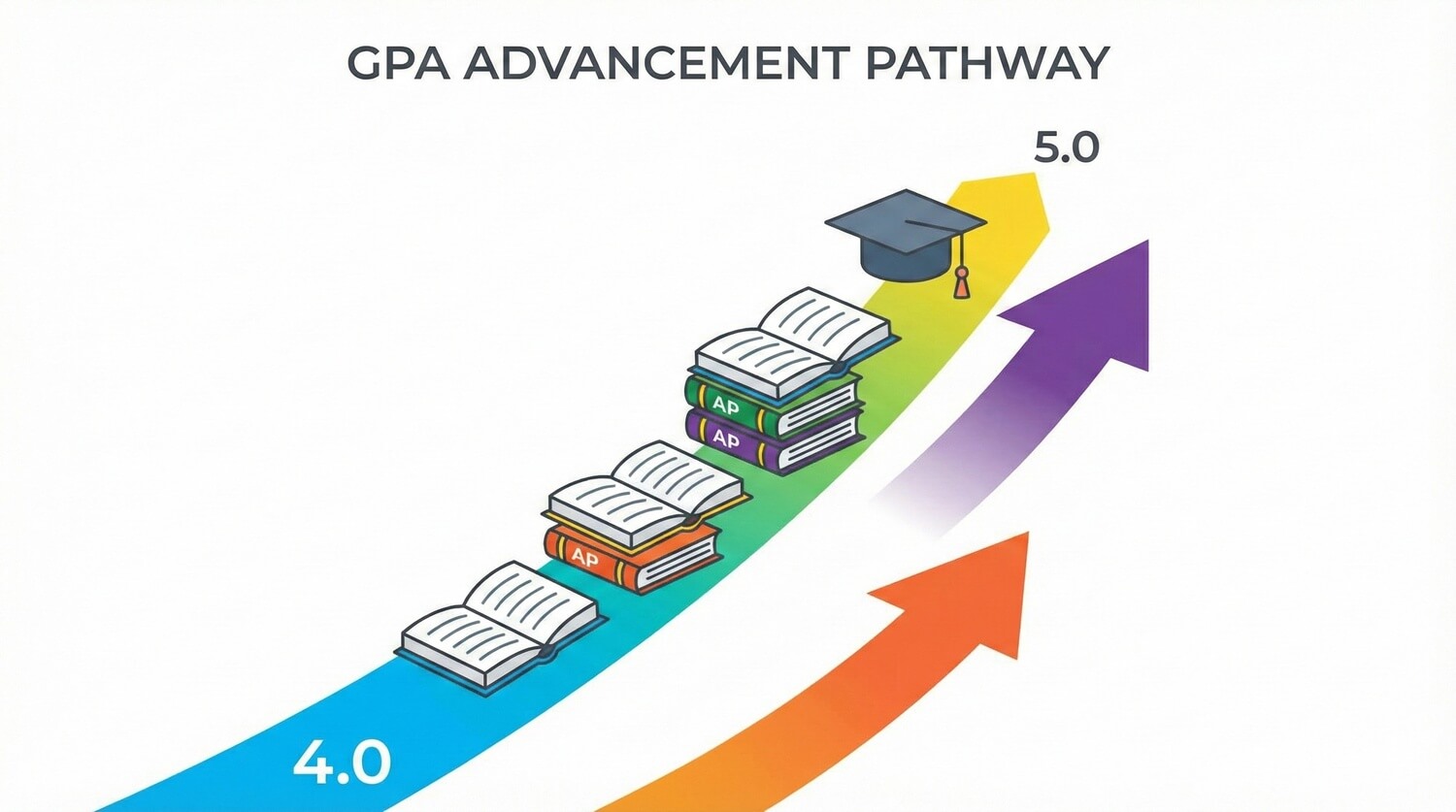
Most high schools use a weighted GPA system. This means an A in an AP class often counts for more points than an A in a regular class. For example, an A in a regular course is usually 4.0. An A in an AP class might count as 5.0.
Here’s an easy example. If you earn an A in an AP class, it may be recorded as 5.0 instead of 4.0. Even a B in AP, which is 3.0 unweighted, can become a 4.0 when weighted. That 4.0 equals an A in a standard class. So AP classes can raise your weighted GPA.
Important: AP classes do not change your unweighted GPA. Unweighted GPA is based only on the letter grades you earn, not on course difficulty. To see the difference, try a GPA calculator. Compare AP grades with regular grades and you’ll see how weights change the total.
Be careful with how many APs you take. They only help if you do well in them. Three or four APs with A’s or B’s usually look stronger than many APs with C’s. Also, AP exam scores do not affect your high school GPA. Only your course grades matter.
Weighted vs. Unweighted GPA and College Admissions
Unweighted GPA is on a 4.0 scale. An A equals 4.0 no matter the class. Every course counts the same. This makes unweighted GPA a fair baseline for comparing students across schools.
Weighted GPA adds extra points for harder classes. Many schools add 0.5 for Honors and 1.0 for AP. That means an A in Honors might be 4.5 and an A in AP might be 5.0. Weighted GPA lets strong students go above a 4.0 average.
Colleges use unweighted GPA because it is standardized. A 3.8 unweighted means the same grades no matter the school. This helps admissions officers compare students fairly.
Weighted GPA matters because it shows rigor. Two students can share a 3.8 unweighted GPA. The one with the higher weighted GPA took tougher courses. Colleges look at both numbers to judge grades and difficulty.
Colleges often recalculate GPA using their own system. Top schools usually check unweighted for grades and weighted for challenge.
Honors classes give a smaller boost than AP. Honors often add 0.5 while AP adds 1.0. So AP classes raise weighted GPA more than Honors.
Do Honors classes boost GPA? Yes. An A in Honors often counts as 4.5 instead of 4.0.
Do AP classes boost unweighted GPA? No. Unweighted GPA ignores course difficulty and only reflects letter grades.
Bottom line: APs do not change your unweighted GPA. They show rigor and can raise your weighted GPA. Together, those numbers help in college admissions.
GPA Comparison Tables
Understanding how GPAs change across standard, Honors, and AP classes is much easier when you see the numbers side by side.
Below are simple tables that show how each letter grade converts in different course levels. These examples use a common weighting system: standard classes get no bonus, Honors adds +0.5, and AP adds +1.0.
Standard vs. AP Classes (Weighted GPA Example)
| Letter Grade | Standard Class | AP Class (Weighted) |
| A (90–100) | 4.0 | 5.0 |
| B (80–89) | 3.0 | 4.0 |
| C (70–79) | 2.0 | 3.0 |
Key insight:
A B in AP becomes a 4.0 weighted GPA — the same value as an A in a standard class. This is one reason colleges value rigor. A strong grade in a harder class tells them more than an easy A.
All 40 AP Courses: Unweighted vs. Weighted
Below is a sample view. The pattern applies to all AP classes:
| AP Course Example | Unweighted GPA (A) | Weighted GPA (A) |
| AP Biology | 4.0 | 5.0 |
| AP English Language | 4.0 | 5.0 |
| AP Calculus AB | 4.0 | 5.0 |
| AP U.S. History | 4.0 | 5.0 |
Every AP course can add +1.0 in many schools.
Honors Classes: Unweighted vs. Weighted
| Honors Course Example | Unweighted GPA (A) | Weighted GPA (A) |
| Honors English | 4.0 | 4.5 |
| Honors Chemistry | 4.0 | 4.5 |
Honors boosts GPA, but AP boosts it more.
Standard/Normal Classes
| Standard Course Example | Unweighted GPA (A) | Weighted GPA (A) |
| English I | 4.0 | 4.0 |
| Algebra I | 4.0 | 4.0 |
GPA Boost in Practice
A student earning five A’s in AP classes might have:
- Unweighted GPA: 4.0
- Weighted GPA: 5.0
This shows clearly how AP classes can raise your weighted GPA while leaving your unweighted GPA unchanged.
Common Questions About AP GPA Boosting
What GPA is a B+ in an AP class?
It depends on your school’s scale, but in a common 5.0 system, an A = 5.0, an A– = 4.7, and a B+ is usually around 4.3 weighted.
Is a B in an AP class good?
Yes. A B unweighted is 3.0, but weighted it becomes 4.0, which equals an A in a regular class.
Is 96% a 4.0 GPA?
At most schools, yes. Many use 93–100% as an A = 4.0 unweighted.
Who got an 11.84 GPA?
This came from viral posts. Extremely high GPAs like that only happen in nontraditional weighting systems, not standard 4.0 or 5.0 scales.
Does Harvard prefer AP or Honors?
Harvard likes rigor in any form. AP, Honors, IB—anything that shows challenge. They look at grades and difficulty together.
What was Einstein’s GPA?
Most claims online are myths. His grades were from another era and don’t match today’s GPA scales.
Is a 1.0000 GPA good?
On a 4.0 scale, no—it means mostly D’s. But if a school uses a 1.0 system, then 1.0 might be perfect. Context matters.
What was Elon’s GPA?
Not verified, and not useful for your goals. Focus on your own path.
Are 5.0 GPAs possible?
Yes, if your school weights AP classes heavily. Straight A’s in AP can push a weighted GPA above 4.0, sometimes close to 5.0.
Strategic Tips for Choosing AP Classes
Choosing AP classes wisely can make a big difference in your GPA and high school experience. Pick subjects you enjoy and already do well in. It is better to earn strong grades in AP classes that fit your strengths than to struggle in ones you do not care about.
Focus on quality, not quantity. Three or four AP classes with A’s or B’s look better to colleges than eight with several C’s. Colleges notice patterns, and they value consistent performance more than sheer numbers.
Try a GPA calculator to see different outcomes. Enter AP, Honors, and regular classes to compare how each affects your weighted and unweighted GPA. This shows clearly whether AP classes boost GPA more than Honors.
Honors classes matter too. They often add 0.5 to your weighted GPA, making them a smart middle choice if AP feels too demanding. Both AP and Honors show challenge to colleges.
Talk to your counselor or a trusted mentor. They can guide you toward APs that match your interests and support your college goals. You do not have to choose alone.
Keep balance in mind. Mix APs with regular classes so you can maintain strong grades and avoid burnout. Use study groups, tutors, or free online help to stay prepared and confident.
Final Thoughts: More Than Just a GPA Boost
AP classes can raise your weighted GPA, but their value goes beyond numbers. They are designed to feel like real college courses. You build skills in writing, problem solving, time management, and critical thinking. Many AP exams can also earn college credit, saving time and money later.
A B in an AP class is still strong. You challenged yourself with harder material, and colleges respect that. Effort in a tough class often looks better than an easy A in a class below your level.
Grades still matter. An A in a regular class plus a B in an AP class is usually better than forcing an AP where you end up with a C. Aim for the best grades you can while staying balanced.
Colleges want to see rigor. Both AP and Honors count. It is not about whether one school prefers AP or Honors. It is about showing you can handle challenges without burning out.
Remember that GPA is not everything. Essays, activities, recommendations, and test scores matter too. AP classes help, but they are only part of the picture.
So do AP classes boost your chances of college admission? Yes, as part of a strong and balanced profile. Use AP classes to learn, grow, and stretch yourself. The GPA boost will follow naturally.