What Is the Chain Rule in Calculus?
The Chain Rule is a differentiation rule used to find the derivative of composite functions—functions in which one function is inside another.
For example:
$$y=(3x^2+5)^4$$
Here, the expression $(3x^2+5)$ is inside the outer function raised to the fourth power. The Chain Rule allows you to differentiate the outer function and then multiply by the derivative of the inner function.
The basic Chain Rule formula is:
$$\frac{d}{dx}[f(g(x))]=f'(g(x))g'(x)$$
In AP Calculus AB and BC, the Chain Rule is covered in Unit 3.1, under Differentiation: Composite, Implicit, and Inverse Functions.
The key idea is simple: differentiate the outside function, keep the inside function unchanged, then multiply by the derivative of the inside function.
AP Calculus Unit 3.1: The Chain Rule
In the current AP Calculus AB and BC course framework, 3.1 The Chain Rule is part of Unit 3, Differentiation: Composite, Implicit, and Inverse Functions. The topic focuses on identifying and applying the appropriate rule to differentiate composite functions.
When Should You Use the Chain Rule?
Use the Chain Rule when you need to differentiate a composite function—one function nested inside another.
$$\begin{aligned} x^2 \sin x &\longrightarrow \text{Product Rule} \\ \sin(x^2) &\longrightarrow \text{Chain Rule} \\ (3x^2+5)^4 &\longrightarrow \text{Chain Rule} \end{aligned}$$
You understand the definition of a composite function. Now you face a trickier challenge. You need to spot the exact moment to use this rule during a timed exam.
Think of sorting mail in a chaotic post office. You must check whether a letter goes into a standard local bin or travels inside an international cargo pouch. Choosing the wrong bin ruins your delivery route. Calculus works the exact same way with your derivative rules.
You must look closely at your function layout before you write anything down. Spotting a function locked inside another function acts as your main trigger. You do not use this rule for basic addition or standard multiplication lines.
Run through this quick mental checklist during your next test. Does your variable hide inside parentheses? Does a trig function wrap around a polynomial term instead of a simple $x$? Do you see an exponent sitting on top of an entire multi-term expression? Finding a yes to any of these questions means the chain rule is required.
Spotting the True Composite Trigger
- Not a Chain Rule Problem: Look at $x^2 \sin(x)$. You see two separate terms multiplied together. You must use the standard product rule here instead.
- True Chain Rule Problem: Look at $\sin(x^2)$. The $x^2$ term sits tucked completely inside the sine function. You must apply the chain rule immediately to peel that inner layer back.
Students often waste precious minutes trying to force product rules onto composite functions. Memorize your triggers now so you can pick the correct path in under five seconds.
The Easiest Way to Remember: The “Outside-Inside” Rule Step-by-Step
You know your triggers. Now you need a bulletproof method to solve the math. Students often struggle with the abstract formula $\frac{d}{dx}[f(g(x))] = f'(g(x)) \cdot g'(x)$. It looks like a foreign language written on a chalkboard.
Think of unwrapping a wrapped gift box. You must deal with the outer wrapping paper before you touch the ribbon or the prize inside. You handle each layer in a strict sequence.
You master this process by following a simple three-action blueprint.
First, leave the inside function completely untouched and take the derivative of the outer layer. You treat the inner expression like a temporary placeholder variable.
Second, multiply that outer result directly by the derivative of the inner layer. Tutors call this step multiplying by the derivative of what is inside.
Third, clean up your algebraic expression to finish the problem cleanly.
Common calculation errors happen when students change both layers at the exact same time. Always finish the outer layer first while keeping the inside safe, then multiply by the inner derivative as a separate final step.
Step-by-Step AP Calculus Worked Examples
You know the theory and the three-step blueprint. Now you need to see how actual free-response problems work. Let us walk through three progressive examples together.
Example 1: Chain Rule with a Power
Picture a heavy cardboard box wrapped tightly with multiple layers of packing tape. You must peel the outer tape before you can open the flaps. You face a similar setup when you need to find $\frac{dy}{dx}$ for $y = (3x^2 + 5)^4$.
You start with the outer layer. Drop that exponent of 4 down to the front. Leave the inside expression completely untouched as $(3x^2 + 5)^3$.
Next, multiply that entire result by the derivative of what is inside. The derivative of $3x^2 + 5$ equals $6x$. Put everything together to get your final derivative of $4(3x^2 + 5)^3 \cdot 6x$.
Example 2: Chain Rule with a Trigonometric Function
Imagine riding a massive roller coaster that loops inside a larger spinning amusement park ride. You deal with double motion at the same time. Trigonometric chain rule problems work right along those lines.
Find the derivative for $y = \sin(5x^3)$. Your outer function is the sine wave, while your inner function is the polynomial term $5x^3$.
Take the derivative of the outer sine layer first. That transforms into a cosine while keeping the inside safe as $\cos(5x^3)$. Then multiply that result by the derivative of your inner term, which gives you $15x^2$. Your complete derivative settles down cleanly as $\cos(5x^3) \cdot 15x^2$.
Example 3: Applying the Chain Rule Multiple Times
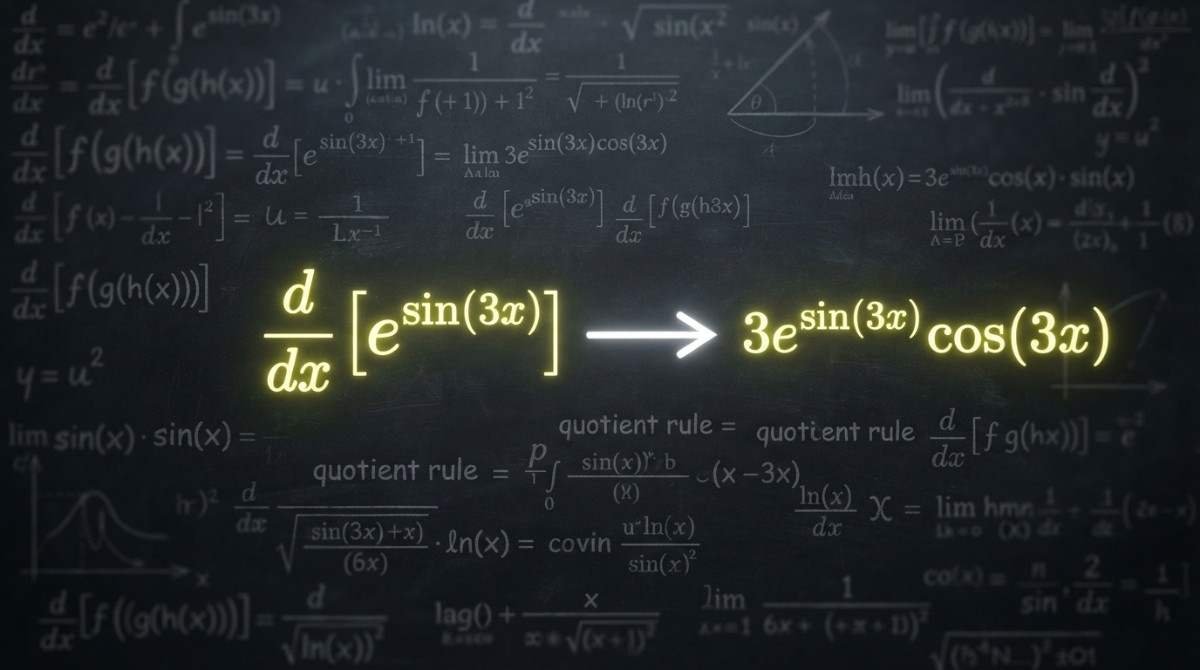
Advanced AP exams love testing your endurance with multi-layer functions. Tackle a tough problem like $y = e^{\sin(4x)}$. This setup requires a double chain rule application because you have three distinct layers nested inside each other.
You peel the layers back one at a time from the outside in. First, take the derivative of the outer exponential function, leaving the inner exponential argument completely intact.
Second, multiply by the derivative of the middle sine layer. Third, finish by multiplying by the derivative of the innermost $4x$ term. Your final answer links all three layers together as $e^{\sin(4x)} \cdot \cos(4x) \cdot 4$.
Write each layer multiplication on a new line if you need to avoid dropping a negative sign or an inner constant.
Avoid the #1 Chain Rule Exam Trap
Forgetting to multiply by the inner derivative is the most common reason students lose points on free-response questions. Download our 6-Page Quick Reference Guide for instant rule lookup and high-yield AP exam trap breakdowns.
Common Pitfalls to Avoid on the AP Exam
You know the steps. You can walk through simple and complex problems with total confidence. Yet, even brilliant students drop easy points on exam day. Watch out for these three classic traps.
Pitfall 1: Stopping Halfway Through the Problem
Imagine running a marathon and stopping five feet before the finish line. You miss out on your medal because you quit early. Students make the exact same mistake when they take the outer derivative and forget to multiply by the inner layer. They stop halfway through their calculation. AP graders deduct precious points instantly for incomplete work. Always finish the final multiplication step every single time.
Pitfall 2: Changing the Inside Function Too Early
Stress makes people mess up their order of operations. Students often panic during a timed test and try to change both layers at once. They alter the inside expression while taking the outer derivative. This illegal move destroys your algebra before you even finish. Remember to keep the inside safe and untouched until you tackle it as a separate multiplication step.
Pitfall 3: Messing Up Notation on Multi-Layer Problems
Complex functions demand clean organization. Students often write messy shorthand notes when multiple layers require sequential applications. They drop negative signs or lose track of inner constants along the way. Clean notation keeps your mind sharp on heavy free-response questions.
If you forget your inner derivative or alter your terms early, your exact wrong answer will sit right there waiting for you. Double-check your layers to secure your score.
Conclusion: Test Your Mastery of Chain Rule in AP Calculus
Before tackling more advanced differentiation techniques, make sure you’re comfortable with the basic derivative concepts and rules