Introduction
Derivatives are one of the core topics you’ll encounter in AP Calculus. To handle techniques like the chain rule and implicit differentiation confidently, it helps to first understand the basic derivative concepts and rules.
Welcome to AP Calculus! If you survived algebra, you already know how to find the slope of a flat, boring straight line. You just pick two points and calculate rise over run. But the real world does not move in straight lines. Think about a roller coaster racing down a steep track or a rocket blasting into the sky. Their speed and direction change every single second.
This is where derivatives change the game. Instead of dealing with fixed lines, calculus lets you study curves that bend, twist, and shift constantly. A derivative simply tells you the exact speed of change at one specific snapshot in time.
Picture driving a car. Your dashboard tells you your exact speed at ten past two. That is not your average speed for the whole road trip. That is your instantaneous speed right now.
In calculus, we call that exact speed a derivative. It is also the slope of a tiny tangent line that just barely kisses a curve at one point.
You do not need a math degree to get this right before your exam. Whether you are cramming the night before a big test or just trying to survive homework, this guide cuts out the confusing textbook jargon. You will get the exact core rules you need to lock down top scores without losing your mind.
What Are the Basic Derivative Rules?
The basic derivative rules you’ll encounter in AP Calculus include the constant rule, power rule, sum and difference rules, product rule, quotient rule, chain rule, and common derivatives for exponential, logarithmic, and trigonometric functions.
AP Calculus Derivative Rules Cheat Sheet
When exam day arrives, you do not have time to scroll through heavy textbooks. You need fast answers right when your brain feels completely fried.
This cheat sheet gives you every core rule in one clean snapshot. Think of it like a shortcut code in a video game that bypasses the boring tutorial levels. You can glance at these formulas and instantly apply them to your homework.
| Rule Type | Formula | Quick Description |
| Constant Rule | $\frac{d}{dx}[c] = 0$ | The slope of any flat number is zero. |
| Power Rule | $\frac{d}{dx}[x^n] = n x^{n-1}$ | Bring the exponent to the front and subtract one. |
| Exponential | $\frac{d}{dx}[e^x] = e^x$ | The natural exponential function stays identical. |
| Logarithmic | $\frac{d}{dx}[\ln(x)] = \frac{1}{x}$ | The slope of a log curve is its reciprocal. |
| Sine & Cosine | $\frac{d}{dx}[\sin(x)] = \cos(x)$ $\frac{d}{dx}[\cos(x)] = -\sin(x)$ | Sine shifts directly into cosine; cosine flips negative. |
| Other Trig | $\frac{d}{dx}[\tan(x)] = \sec^2(x)$ $\frac{d}{dx}[\cot(x)] = -\csc^2(x)$ | Tangent links to secant squared; cotangent to cosecant. |
| Sec & Csc | $\frac{d}{dx}[\sec(x)] = \sec(x)\tan(x)$ $\frac{d}{dx}[\csc(x)] = -\csc(x)\cot(x)$ | Secant and cosecant pair with their respective co-functions. |
Top math teachers recommend memorizing these core patterns instead of relying blindly on flashcards. When you understand the underlying rhythm of these functions, exam questions feel much less intimidating.
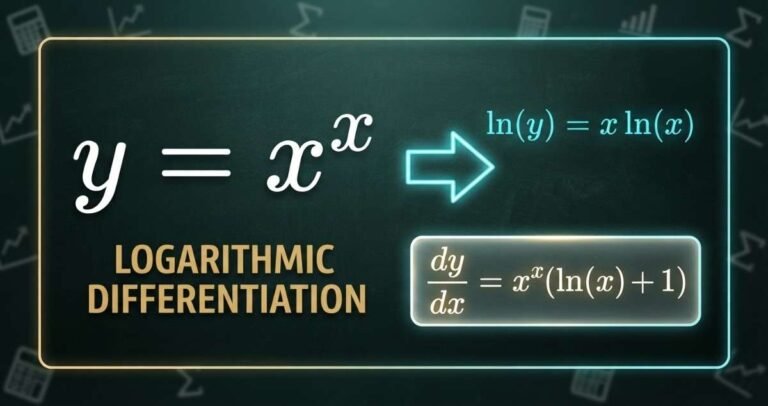
However, standard shortcuts will fail you if you face complex structures with variables trapped in both the base and the exponent. You will want to review our guide on AP Calculus Logarithmic Differentiation to conquer those specific tricky problems effortlessly. Bookmark this section right now so you can review these essential rules before every major quiz.
Foundational Building Blocks: From Pre-Calc to Calculus
Before you start using fast shortcuts, you need to understand how we shift from algebra to calculus. Imagine you take a road trip across your state. You check your GPS halfway through and see your average speed was sixty miles per hour. That single number summarizes your entire journey over a long stretch of time.
Calculus does something entirely different. It answers a much sharper question. What was your exact speed the millisecond you passed a speed camera? That is your instantaneous rate of change.
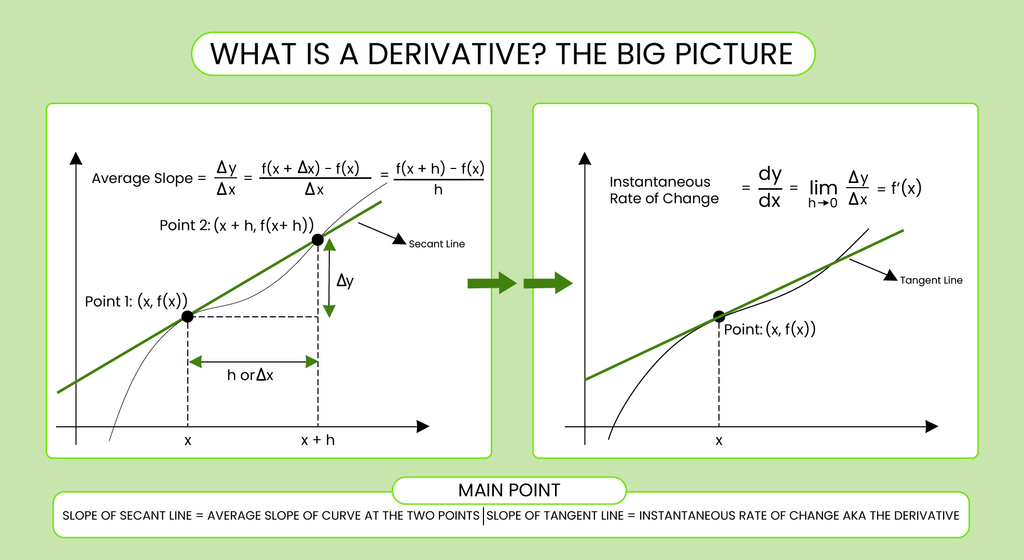
To find that exact speed, mathematicians use secant lines and tangent lines. A secant line connects two separate points on a curve to show your average speed over a gap. As you shrink that gap closer to zero, the secant line tilts and flattens into a tangent line. That final tangent line touches the curve at just one single point.
This brings us to the formal limit definition you will see on homework assignments. The formula looks like this:
$$f'(x) = \lim_{h \to 0} \frac{f(x+h) – f(x)}{h}$$
Think of it as building a bicycle from scratch before you ride a motorcycle. It proves why the rules work.
Once you survive the proof stage, you will use clean shorthand notation on your tests. AP graders throw out different symbols to test your flexibility. You will spot $f'(x)$ written by Lagrange, $\frac{dy}{dx}$ written by Leibniz, or simple variations like $y’$ and $D_x y$. They all mean the exact same thing. They all ask you to find the slope of that tangent line right now.
The Core Rules of Differentiation (With Step-by-Step Examples)
Now that you survived the limit proofs, you unlock the real superpower of calculus: shortcut rules. Picture baking cookies. Instead of grinding your own wheat and milking a cow every time, you grab a ready-made bag of flour from your pantry. Basic rules let you skip the painful algebra and solve problems in seconds.
The constant rule says the derivative of any plain number is always zero. Think about a flat parking lot. It has zero slope. The sum and difference rules let you chop long polynomial equations into bite-sized pieces and solve them one term at a time.
Next comes the famous power rule. It handles positive integers, negative exponents, and messy fractional roots with ease. You just pull the exponent down to the front and subtract one from the top power. For instance, the derivative of $x^3$ transforms neatly into $3x^2$.
Things get slightly trickier when functions multiply or divide each other. You cannot just take separate derivatives like an amateur. You must use the product rule or the quotient rule to keep your calculations accurate. Think of it like operating a complex camera rig where every adjustment impacts the final picture.
Some functions require an even deeper toolkit, especially when equations loop inside of other equations. Because composite functions appear everywhere on the exam, you will want to master the mechanics using our dedicated AP Calculus Chain Rule guide. Top math educators stress that mastering this specific rule separates average students from top scorers. When you lock down these core patterns, your next exam will feel like a walk in the park.
Free Download: Complete AP Calculus Derivative Quick-Reference Guide
Want the essential AP Calculus derivative rules in one place? Download the free Quick-Reference Guide for a printable summary of the rules, formulas, and common derivative patterns.
AP Exam Insights & Common Pitfalls
Knowing the rules is only half the battle on the AP exam. The College Board loves to test your conceptual flexibility using data tables instead of standard algebraic formulas. Picture reading a nutrition label on a food package to track your exact daily intake. You must pull specific numbers from rows and columns to calculate your final answer.
Table problems require you to evaluate derivatives by combining function values and given data points. You will often see composite functions hidden inside these grids. While basic rules handle explicit functions easily, what happens when variables are tangled together? Learn how to handle these scenarios using our guide on implicit differentiation for AP Calculus.
Another major trap involves graphical differentiability. Students often assume a smooth curve exists everywhere, but the exam loves to trick you with sharp corners, cusps, vertical tangents, and broken lines. A derivative fails to exist at any point where the graph makes an abrupt turn or a sudden jump. Experienced calculus teachers note that spotting these non-differentiable spots instantly saves students from careless errors.
Let us look at a quick AP-style problem to see how this works in practice. Suppose you need to find the derivative of $f(x) = 3x^4 – 5x^2 + 7$ at the point where $x = 1$. You apply the power rule to each term to get $12x^3 – 10x$. Plugging in your $x$ value gives you an exact answer of $2$. Practice these steps daily, and you will crush your next test.
Frequently Asked Questions
H3: Are derivatives the hardest part of calculus?
Students often panic when they first hear the word derivative. Think of it like learning to ride a bicycle for the very first time. Your brain feels overwhelmed by balance, pedaling, and steering all at once. Once you practice the core rules, the fear vanishes entirely. Derivatives are actually just logical puzzles that follow predictable patterns.
H3: What is harder, integrals or derivatives?
Calculus students debate this question constantly. Finding a derivative feels like following a recipe to chop ingredients into smaller pieces. Integrals work backward like trying to rebuild a smashed puzzle from those tiny pieces. Mastering derivatives first builds the exact mental muscles you need to survive integrals later.
H3: What are the 7 rules of derivatives every student must memorize?
You do not need to memorize hundreds of complex formulas to pass your exams. You only need seven foundational building blocks. These include the constant rule, power rule, sum and difference rules, product rule, quotient rule, chain rule, and basic trigonometric functions.
H3: What grade is calculus derivatives typically taught?
Most schools introduce basic derivatives during senior year of high school in AP Calculus AB or BC. Some advanced students tackle these concepts during junior year or early college semesters. Age does not determine your success with this material. Consistent daily practice and clear conceptual cheat sheets help any beginner master the topic quickly.