Is Logarithmic Differentiation on the AP Calculus Exam?
Logarithmic differentiation is a useful calculus technique for differentiating functions that are difficult to handle with standard differentiation rules, particularly when the variable appears in both the base and exponent, such as . However, logarithmic differentiation is not listed as a named topic in the current AP Calculus AB/BC course topic summaries from College Board.
That distinction is important: logarithmic differentiation is a useful calculus technique, but that does not necessarily make it a specifically named AP exam requirement. If you’re preparing for AP Calculus, it is still useful to understand how the technique works, especially because it provides another way to differentiate complicated expressions.
Before diving into logarithmic differentiation, make sure you have a solid understanding of the basic derivative concepts and rules. These fundamentals make it much easier to understand what is happening when we transform and differentiate more complicated expressions.
So, what exactly makes logarithmic differentiation useful?
Picture this. You stare at a terrifying math problem where variables hide in both the base and the exponent, like $$y = x^x \quad \text{or} \quad f(x) = (\sin x)^x$$
Your trusty power rule crashes. Your exponential rule breaks. Panic sets in right before your big exam.
Logarithms give us a way to transform those complicated relationships into forms that are much easier to differentiate.
Math pros call this trick logarithmic differentiation. It sounds fancy, but the core idea is simple: take the natural logarithm of both sides, use the properties of logarithms to simplify the expression, differentiate implicitly, and then solve for the derivative.
Let us dive into the mechanics and see how this trick actually works.
What is Logarithmic Differentiation and When Do You Use It?
You now know that logs act like a secret weapon. But when should you actually pull this tool from your backpack? You face two main scenarios on the AP exam where standard formulas fail.
The first scenario involves variable-in-the-exponent functions. Think back to basic algebra rules. You learned how to handle $x^2$ using the power rule. You learned how to handle $2^x$ using the exponential rule. What happens when a variable sits in both spots like $x^x$? Neither rule works. Your normal formulas break down completely.
The second scenario features massive multi-term products and quotients. Imagine a fraction packed with five distinct polynomial layers. Applying the standard quotient rule four times in a row leads to algebraic chaos. You will run out of paper and sanity before you finish simplifying.
Think of it like sorting an entire warehouse of random inventory. You could try counting every single item by hand one item at a time. Or you could use a scanner to group everything into clean categories instantly. Logarithmic differentiation acts as your instant inventory scanner for heavy calculus problems.
Top-scoring AP calculus students look at a function structure before they write a single line. If they spot a variable exponent or a brutal chain of products, they skip the standard rules immediately and opt for logs.When should you use log vs ln?
When should you use log vs ln?
You can use logarithms with different bases, but natural logarithms $\ln$ are especially convenient in calculus because $\frac{d}{dx}\ln(x)=\frac{1}{x}$. For logarithmic differentiation, using $\ln$ keeps the derivative formulas simple.
The 3-Step Logarithmic Differentiation Blueprint
You now recognize the exact moments when standard calculus formulas fail. You need a reliable roadmap to solve those heavy problems. Master this simple three-step blueprint to conquer any exponential trap on your exam.
Step 1: Take the Natural Log of Both Sides
Start by attaching a natural log to every term on the left and right sides of your equation. You write this down as $\ln(y) = \ln(f(x))$. This single move brings your trapped variables down to earth.
Step 2: Expand Using Logarithm Properties
Never try to take the derivative immediately after taking your logs. Instead, use your log rules to tear messy expressions apart. You rely on three critical rules for the AP exam. The product rule turns multiplication into addition like $\ln(ab) = \ln(a) + \ln(b)$. The quotient rule splits fractions into subtraction like $\ln\left(\frac{a}{b}\right) = \ln(a) – \ln(b)$. The power rule pulls exponents straight down into coefficients like $\ln(a^b) = b \cdot \ln(a)$.
Master Logarithmic & Exponential Derivatives
Want the essential logarithmic and exponential derivative rules in one place? Get the free AP Calculus Reference Guide.
Step 3: Implicitly Differentiate and Isolate $\frac{dy}{dx}$
Now you take the derivative of every single term with respect to $x$. Remember your implicit differentiation rules. The left side of your equation always yields $\frac{1}{y} \frac{dy}{dx}$ because of the chain rule. Finish the problem by multiplying both sides by $y$ to isolate your final derivative.
When the derivative is complete, substitute the original expression back in for $y$ if your final answer needs to be written entirely in terms of $x$.
Step-by-Step AP Calculus Worked Examples
You understand the core three steps. Now let us walk through two real AP free-response exam problems. Seeing these methods in action changes everything.
Example 1: The Classic Variable-in-Exponent Problem
Picture a chef trying to adjust a recipe where ingredients scale exponentially against time. You face a similar setup when you need to find $\frac{dy}{dx}$ for $y = x^x$. Your normal power rule fails instantly because your variable sits right up in the exponent.
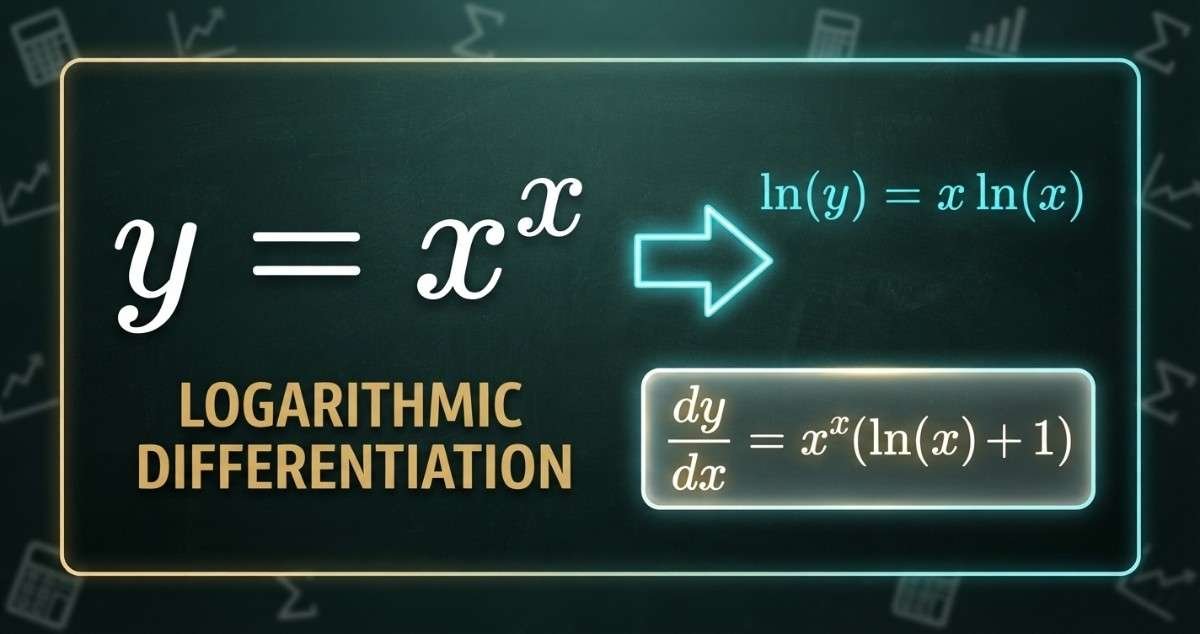
You fix this by taking the natural log of both sides. Your equation transforms into $\ln(y) = \ln(x^x)$. Apply your log rules immediately to pull that pesky exponent down into a coefficient. You now have $\ln(y) = x \cdot \ln(x)$.
Next, take the derivative of both sides with respect to $x$. The left side becomes $\frac{1}{y} \frac{dy}{dx}$ and the right side requires the standard product rule. You get $\frac{1}{y} \frac{dy}{dx} = 1 \cdot \ln(x) + x \cdot \frac{1}{x}$. Clean up that right side to get $\ln(x) + 1$.
Finally, multiply both sides by $y$ to isolate your derivative. Swap your original function back in for $y$ to get your final answer of $\frac{dy}{dx} = x^x(\ln(x) + 1)$.
Example 2: The Multi-Layer Product and Quotient Nightmare
Imagine carrying five heavy boxes up a steep flight of stairs all at once. You will likely drop something along the way. Students face this same algebraic disaster when tackling heavy fraction functions like $y = \frac{(x-2)^3 \sqrt{x+1}}{4x-5}$ on the AP exam.
Applying the standard quotient and product rules directly here leads to massive algebraic chaos. You will waste valuable minutes expanding terms and making silly sign mistakes. Taking natural logs first saves your grade.
You attach a natural log to both sides. Then you expand every piece using your log properties. Multiplication turns into addition. Division turns into subtraction. Exponents slide straight down out of harm’s way.
Your massive fraction breaks down into a clean line of simple addition and subtraction terms. You take the derivative of each simple term in seconds. Multiply the entire result by your original $y$ function at the very end.
3 Common Pitfalls to Avoid on the AP Exam
You have your blueprint ready. You know how to take logs and run derivatives smoothly. Yet, even brilliant students drop easy points on exam day. Watch out for these three classic traps.
Pitfall 1: Leaving a Stray $y$ Variable Behind
Imagine baking an expensive custom cake and forgetting to add the frosting layer before delivery. You fail to finish the presentation. Students make the exact same mistake when they finish the calculus work and forget to swap $y$ back in. They leave a stray $\frac{dy}{dx}$ formula tied to a leftover $y$ variable on the left side. AP graders deduct precious points instantly for incomplete substitutions. Always replace that $y$ with your original function in terms of $x$ at the very end.
Pitfall 2: Breaking Logarithm Rules Under Pressure
Stress makes people invent math rules that do not exist. Students often panic during a timed test and distribute logs across addition. They treat $\ln(a + b)$ as $\ln(a) + \ln(b)$. This illegal move destroys your algebra before you even start the calculus. Remember that addition stays locked inside logs. You can only split multiplication and division apart.
Pitfall 3: Forgetting the Chain Rule on Inner Functions
Taking the derivative of $\ln(x)$ gives you a clean $\frac{1}{x}$. Students get comfortable and forget what happens when the inner term is more complex. If you take the derivative of $\ln(u)$, you must multiply your result by $\frac{du}{dx}$ every single time. Skipping this inner chain rule ruins your final answer layout.
Visual Walkthrough
Prefer to see logarithmic differentiation worked out step by step? Watch the video below.
Seeing someone else work through the cancellation steps changes everything. You can watch how experienced tutors handle messy exponents and track negative signs. Pause the clip whenever you need to check your own scratchpad notes.
Ready to Test Your Mastery?
Don’t stop at the theory. Put your skills to the test right now with our comprehensive implicit differentiation practice set complete with step-by-step solutions. You can also explore our implicit differentiation guide to lock down your derivatives foundation before exam day arrives.